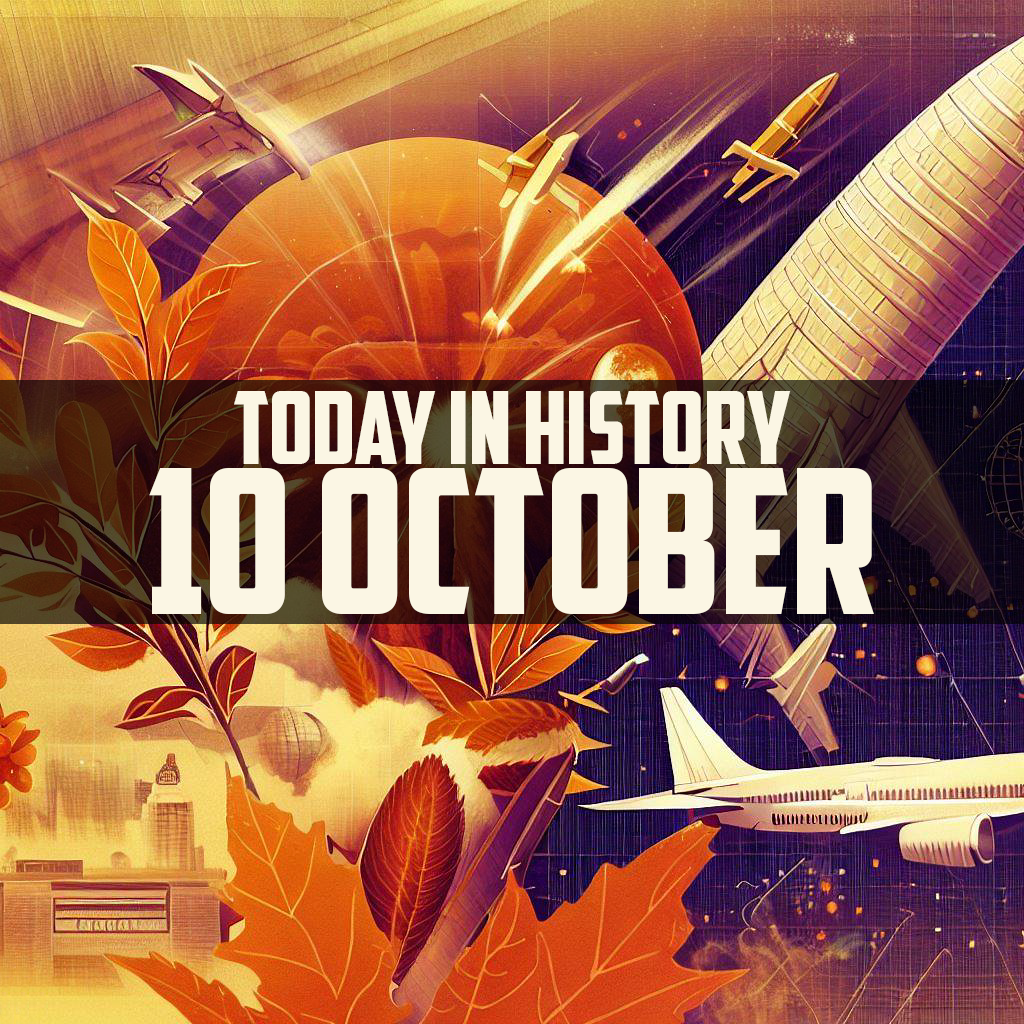
October 10th, like every other day on the calendar, has been a witness to various transformative events in global history. As we embark on this journey through time, we’ll uncover pivotal moments that have shaped nations, altered the course of science, influenced the arts, and forever changed the lives of individuals.
Today in History: 10 October

1. The Founding of the Republic of China (1911)
One of the most significant events of the 20th century was the Wuchang Uprising, which marked the onset of the Xinhai Revolution. This rebellion led to the fall of the Qing Dynasty, ending over two millennia of imperial rule in China. Subsequently, the Republic of China was established on January 1, 1912, with Sun Yat-sen as its first provisional president. The legacy of October 10th is celebrated as the National Day or Double Ten Day in Taiwan.
2. The Birth of Giuseppe Verdi (1813)
Italian composer Giuseppe Verdi was born on this day. Recognized as one of the opera’s preeminent figures, Verdi’s compositions, including classics like “La Traviata,” “Rigoletto,” and “Aida,” have delighted audiences for over a century. His ability to evoke profound emotion through music has cemented his place in the pantheon of great composers.
3. The United States Naval Academy Opens (1845)
In Annapolis, Maryland, the U.S. Naval Academy officially welcomed its first class of midshipmen. Designed to produce officers for the U.S. Navy and Marine Corps, the academy has since become one of the country’s most prestigious institutions for higher learning.
4. The Pledge of Allegiance (1892)
Penned by Francis Bellamy, the Pledge of Allegiance was first recited in public schools across the United States. Initially composed for a celebration marking the 400th anniversary of Christopher Columbus’s arrival in the Americas, the Pledge underwent several revisions before reaching its present form.
5. The Universal Postal Union (UPU) is Established (1874)
Founded in Bern, Switzerland, the Universal Postal Union was created to streamline and simplify international mail delivery. Before its inception, sending mail internationally was a complex and expensive process. With the UPU’s establishment, member countries could easily exchange mail, propelling global communication forward.
6. The Air India Flight 182 Bombing (1985)
One of aviation’s deadliest terror attacks occurred when Air India Flight 182 exploded mid-air, killing all 329 people on board. The flight, travelling from Montreal to Delhi, was brought down by a bomb planted by Sikh extremists in retaliation for the Indian government’s actions against the Golden Temple in Amritsar the previous year.
7. The Achille Lauro Hijacking (1985)
On the same day as the Air India bombing, Palestinian terrorists hijacked the Italian cruise ship Achille Lauro. Their initial plan, which was to attack an Israeli port, failed, leading them to seize the ship instead. The hijackers killed Leon Klinghoffer, an American Jewish passenger. This event intensified international concern over maritime terrorism.
8. Fiji becomes a Republic (1987)
On October 10, 1987, Fiji officially became a republic, severing its ties with the British monarchy. This decision came on the heels of a military coup earlier that year, in which the government was overthrown due to ethnic tensions between indigenous Fijians and Indo-Fijians.
9. “The Jazz Singer” Premieres (1927)
Heralding a revolution in the film industry, “The Jazz Singer” made its debut. Known as the first prominent “talkie,” this film signalled the end of the silent film era. It not only incorporated synchronized singing sequences but also featured segments with synchronized speech.
10. The Battle of Tours (732 AD)
Also known as the Battle of Poitiers, this confrontation between the Frankish and Burgundian forces under Charles Martel and an army of the Umayyad Caliphate led by Abdul Rahman Al Ghafiqi took place. The Franks emerged victorious, halting the Islamic advance into Western Europe. This battle is often cited by historians as a pivotal moment in preserving Christian Europe’s religious and cultural identity.
In Conclusion:
October 10th’s historical tapestry is a rich interweaving of human endeavour, ingenuity, conflict, and progress. Each event, large or small, offers insights into humanity’s evolving journey. Whether it’s the sweeping changes brought about by revolutions and wars or the subtle shifts caused by artistic and technological advancements, this day reminds us of the impermanence of time and the lasting impact of our collective actions. As we reflect upon these events, we recognize the power of a single day to encapsulate the hopes, fears, achievements, and tragedies of the human experience.