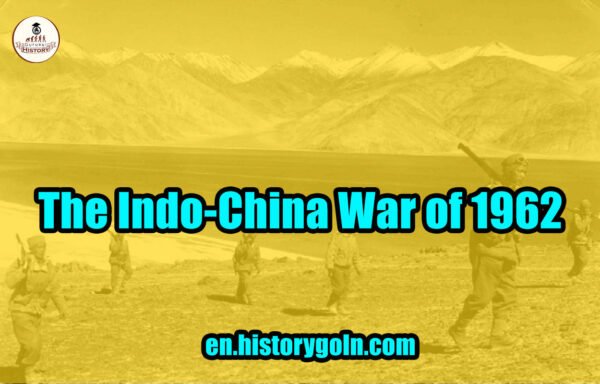
The Indo-China War of 1962 was a border conflict between India and China. The war lasted for one month from October 20 to November 21, 1962, and resulted in China’s victory. The conflict primarily took place in the Himalayan region and was the culmination of a long-standing border dispute between the two countries. This blog post will provide an overview of the Indo-China War of 1962, including its causes, major events, and consequences.
The Indo-China War of 1962
Causes of the War:
The border dispute between India and China can be traced back to the British colonial era when India was under British rule and Tibet was an independent country. The McMahon Line, named after Sir Henry McMahon, a British colonial administrator, was drawn in 1914 to demarcate the border between India and Tibet. The McMahon Line was never recognized by China, and after the Chinese Communist Party came to power in 1949, the Chinese government claimed large parts of the Indian territory as their own. The dispute between India and China over their borders was further aggravated by the fact that India granted asylum to the Dalai Lama, the spiritual leader of Tibet, who fled to India in 1959 after a failed uprising against the Chinese government. China saw this as a direct challenge to their authority over Tibet and considered India a hostile country. In 1960, China built a road through Aksai Chin, an area claimed by India as part of the state of Jammu and Kashmir. India protested against the construction of the road, but China refused to halt the work. The construction of the road increased tensions between the two countries and led to the deployment of troops along the border. Major Events of the War: In September 1962, China launched a surprise attack on Indian posts along the border. The Indian troops were ill-equipped and poorly trained, and the Chinese forces quickly overran the Indian positions. The Chinese army advanced rapidly into Indian territory and captured several strategic locations, including Tawang in Arunachal Pradesh, which was a major setback for India. The Indian Air Force tried to intervene, but the Chinese air force had superior aircraft and had complete control of the skies. The Indian troops were outnumbered and outgunned, and they had to retreat to avoid being surrounded by the Chinese forces. The war ended on November 21, 1962, when China declared a unilateral ceasefire and withdrew its troops to the pre-war positions. India had suffered a humiliating defeat, with over 1,300 soldiers killed and over 1,000 wounded. China’s casualties were estimated to be around 700 soldiers.
Consequences of the War:
The Indo-China War of 1962 had far-reaching consequences for both India and China. India’s defeat was a severe blow to its national pride and its image as a regional power. It also exposed the weaknesses of India’s military and led to a major overhaul of the country’s defense strategy. The war also had a significant impact on India’s relations with other countries. India became more closely aligned with the Soviet Union, which provided it with military and economic assistance. India also improved its relations with the United States, which had previously been hesitant to provide assistance to India. For China, the war was a major victory that demonstrated its military prowess and reinforced its claim to the disputed territories. China’s victory in the war also led to an increase in its global stature and helped establish it as a major player in international politics. The Indo-China War of 1962 was a watershed moment in the history of India and China. The conflict was the culmination of a long-standing border dispute between the two countries and had far-reaching consequences for both. While the war was a military victory for China, it had significant political and strategic implications for both India and China.
Album of The Indo-China War of 1962: