Today is our topic of discussion Kazi Nazrul Islam .
Kazi Nazrul Islam
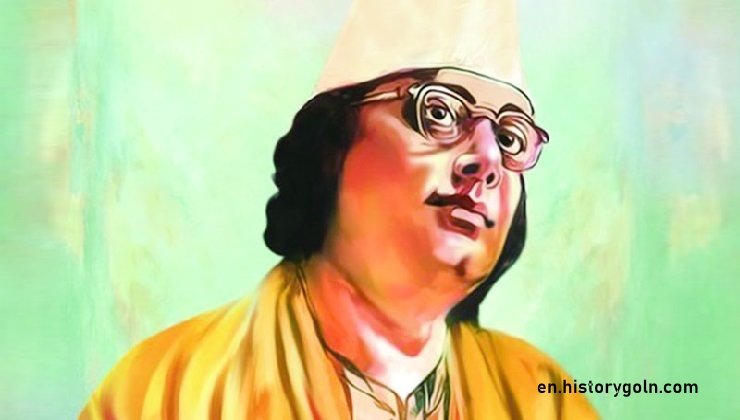
An analysis of Nazrul Islam’s works would help us to understand the complexities of Bengali Muslim society and politics in the years between the two world wars. Nazrul embodied the spirit of the age. His works represented the variety, conflict and the fusion of diversified ideas that existed in Bengali society in the first half of the twentieth century.
Nazrul started writing in 1919 when he was only twenty years of age and still stationed at Karachi as a sergeant with the 44th Bengal Regiment of the British Indian Army. He returned to Calcutta in March, 1920 when his regiment was disbanded and took up journalism as a career. He continued writing poems, short stories, novels and songs seriously and almost with a spontaneous zeal.
Nazrul’s arrival in Bengal was at a time when the province was going through a period of transition. The after-war years were marked with social shar tension, inflation and unemployment Gandhi’s non-co-operation movement after the Jalianwallall Bagh massacre (1919) and the failure of the movement after the Chauri-Chaura incident (1921) had disillusioned the Bengal Congress leaders.
The nationalist leaders were divided into several factions. C.R. Das had rejected Gandhi’s leadership and had challenged his position as the leader of the nationalist movement on the all-India level. The extremist elements led the terrorist movement against the British government. The Muslims in Bengal in general as in the other provinces of India, supported the Khilafat movement (1919-24) in order to protect the Caliphate in Turkey.
They gave priority to their religious identity and considered themselves Muslims primarily but were still not conscious of nationalism in the territorial sense of the term. They identified themselves with the Muslim community of the world, the Muslim ummah. Protection of the Caliphate symbolised to them protection of the religion of Islam. With the abolition of the Caliphate in 1924 the Khilafat movement subsided.
In Bengal, extremist politicians were active since the Swadeshi movement which started around 1903. Repressive measures during the first world war managed to bring the terrorists under control. As the war ended, the extremist nationalists joined Gandhi’s non-co-operation movement with the hope that some political concessions could be achieved from the British government.
But, as the movement failed, the extremists were disappointed with Gandhi’s strategy and were impatient to resume their terrorist activities A section of the younger generation, inspired by the Bolshevik Revolution in Russia in 1917 was secretly preparing to organize a group on Communist ideology. The Muslims, too, were disenchanted and frustrated. In Bengal, an emerging group of English educated Muslims under the leadership of A.K. Fazul Huq began to participate in provincial politics.
For the Bengali Muslims, the 1920’s marked the end of an era and the beginning of a new. Nazrul Islam arrived in 1920 in the midst of a diversified socio-political miles. In the realm of literature, two broad trends existed among the Bengali Muslim writers since the last decade of the nineteenth century.
One group of writers which included Shaikh Abdur Rahim (1859-1931), Mohammad Mozammel Huq (1860-1933), Munshi Mohammad Reazuddin Ahmed (1862-1933) Mohammad Moniruzzaman Islamabadi (1875-1950) were Pan-Islamists.
They dreamt of reviving the past glory of Islam through recounting the lives of Muslim heroes and saints including Prophet Muhammad. They were aware of the destitution of the Muslims in socio-economic and political spheres and wanted to salvage them from that condition by reminding them of their glorious past. They also felt the need to educate the Muslims and sought to make the Bengali language more Islamic by the use of Arabic, Persian and Urdu words.
The other group included politically and socially conscious writers like Kazi Abdul Wadud (1894-1970), Kazi Motahar Hossain (1897-1981), S. Wajed Ali (1890- 1951). Abul Fazl (1903-1983), Humayun Kabir (1906-1969), Abdul Qadir (1906-1984) and others. They believed that for the Bengali Muslims, Bengali was to be their mother-tongue and their medium of expression in every respect.
On the question of Bengali Muslim identity, which was a controversial subject since the late nineteenth century this group of intellectuals believed that they were Bengalees first and Muslims second. They were critical about the Pan-Islamic movement and inspired by the idea of Bengali nationalism rather than Muslim nationalism, they advocated communal harmony.
Nazrul Islam belonged to the latter group. He embodied the progressive, secular and humanist trends. He appeared suddenly and astonishingly as a comet and established himself as a poet and a writer.
He represented a trend quite radical for his time. He startled the Bengali Muslims with his somewhat revolutionary views and bold writings. With his liberal and humanistic approach, he preached communal harmony and called for the establishment of a society free from all kinds of oppression and exploitation.
Even the enlightened group of Bengali Muslim writers had not yet declared so openly and directly the need for wiping out social orthodoxy. religious conservatism, inequality and poverty. Nazrul’s bold attack on the very citadel of orthodox Islam was sudden and new. No other writer before him had made such a frontal attack on conservatism. Nazrul made a tremendous impact on the Bengali Muslims and Hindus alike. The radicals, particularly, acclaimed him as the “rebel poet” or the “poet of revolution”
Soon after returning from Karachi in 1920, he met Muzaffar Ahmad in Calcutta and was influenced by communist ideology 3 Nazrul Islam did not get affiliated to the Communist Party.
He could not adhere to any party discipline. He believed in revolutionary changes in the society where exploitation of the poor by the rich would end, where people of all castes and creeds would enjoy equal treatment, where religious orthodoxy and social conservatism would shed all extremisties. Nazrul Islam was neither a philosopher nor a politician. He did not either fall into the category of the intelligentsia because he was guided more by emotion than by reason. He was a humanist who believed in the excellence lying in the heart of all human beings.
Above all, he was a poet who wrote plainly and spontaneously with extreme emotion and exitement against all oppressions, exploitation, conservatism and hypocrisy. Nazrul Islam worked in the Navajoog (New Age or New Era) a newspaper which was brought out by the popular Bengali Muslim politician A.K. Fazlul Huq around 1920-21.4 In it, he spoke out boldly for relieving the problems of the labourers and agriculturists of Bengal.
Around 1922 Nazrul began to work as the editor of the Dhumketu (the Comet) in which he openly demanded complete independence of India 5 Both the extremist and moderate nationalist leaders of Bengal in the 1920’s talked of complete independence but none did yet so boldly demand it as Nazrul did.6 Nazrul was swayed much by emotion in his writings and his bold and direct language attracted and inspired the younger generation of the Bengalees After the failure of Gandhi’s non-co-operation movement (1919-1922) there was a lull in the political atmosphere of the country.
Nazrul wanted to revive the revolutionary spirit by encouraging the terrorist and extremist groups although he was not a member of any of those. Neither did he participate in any of their activities. Nazrul was critical of Gandhi’s non-co-operation movement and his preaching of spinning cotton and weaving khadi at home in order to boycott foreign cloth.
Nazrul considered Gandhi’s strategy a failure. Nazrul’s opinion was that Gandhi’s principle of non-violence or Ahimsa no longer created inspiration among the general people who alone, he believed, could put life to the nationalist movement. Nazrul was also critical of the participation of Bengali Muslims in the Khilafat movement and of their constant harping on their links with Turkey and the Arab world.
This, he believed, had created in them a feeling that they were aliens in Bengal. This attitude further contributed to establish in their minds a feeling that their identity in Bengali was as Muslims and not as Bengaloes. This was a very unrealistic attitude since most Muslims in Bengal were of indigenous origin. In short, Bengali Muslims were suffering from an identity crisis.
Nazrul tried to evoke in the minds of the Bengali Muslims that they were Bengalees as a nation and that religious exclusiveness would lead to a more bleak future. In the Dhumketu, Nazrul wrote in 1922.
Nazrul praised Mustafa Kamal’s steps to modernize the society in Turkey by abolishing the Caliphate in 1924. Nazrul attempted to inspire the Bengali Muslims to bring similar changes in Bengal as well. Earlier, in 1920, Nazrul had composed several poems on Islamic and Perso-Arabic themes like “Kamal Pasha”.
“Anwar. “Shatt-el-Arab 11 “Qurbani” (Sacrifice), “Muharram 12 “Fatcha-1-Do’Azdaham”13, “Kheya Par-er Tarani” (Boat to cross the river) which extolled the past glory of the Muslims and at the same time expressed regret and disappointment at the subsequent degeneration of the Muslims, particularly in Bengal.
In “Anwar” and “Kamal Pasha”, Nazrul evoked the Muslims of India to arise from the state of slumber. He criticized them for their cowardice and conservatism which, he believed, had turned them into tame creatures”.
Nazrul wrote in “Anwar”,
” দুনিয়াতে মুসলিম আজ পোষা জানোয়ার
(“The Muslims in the world today are tame creatures!”)
Nazrul was the precursor of Muslim renaissance in Bengal. He praised the reform movement by Kamal Pasha and contrasted that to the degeneration of the Muslims in Bengal and the whole of India. In the same poem he wrote,
“কে বলে সে মুসলিম জিভ ধরে টানো তার ।
বেঈমান জানে শুধু জানটা বাঁচানো সার।
আনোয়ার ধিক্কার
কাঁধে ঝুলি ভিক্ষার
আনোয়ার শুরু যার স্বাধীনতা শিক্ষায়,
যারা ছিল দুর্গম আজ তারা সিকদার ।
আনোয়ার শিকার
(“Who says he is a Muslim, tear his tongue apart.
Traitor he is, knows nothing but saving his own life.
Despicable Anwar
With sword who had once been taught to protect independence,
Has alms-receiving bag on his shoulder-
Those who are undaunted carry the helm today,
Worthless Anwar.”)
To revive the courage and the lost pride of the Muslims. Nazrul wrote “Shatt-el-Arab”. Through this poem Nazrul tried to arouse the conscience of the Muslims of Bengal and urge them to make attempts to come out of their hapless impasse, What was new about Nazrul’s call for Muslim revival in Bengal was that his precursors had reminded the Muslims of their past glory looking to the past, while Nazrul looked to the future for such revival,Nazrul wrote the poem “Qurbani” (Sacrifice) as a protest against communal strife between Hindus and Muslims over the slaughter of cows.
Nazrul used the symbol of love implied in the story to point out that one’s patriotic fervour should be so as to make one sacrifice one’s life and the lives of one’s dear ones for the love of the motherland. Religious squabbles on such petty issues like the slaughter of cows only exposed religious orthodoxy and narrow-mindedness, 18 Nazrul believed in secularism and therefore, criticized both Muslims and Hindus for their intolerant attitude to each other.
Nazrul wrote a satiric poem, “De gorur ga Dhuye” (wash the cow’s body) which became a popular phrase to those who opposed communalism and hated killings just for this reason. The poem is a comic chorus but carries severe criticism of the Hindu attitude of “touch-me-not” and the exclusiveness created by the two communities in their dresses and appearances, for instance.
Muslim men grow beards and wear pyjamas and topi (caps) while the Hindus wear dhoti (loin-cloth) and grow tikis (a tuft of hair on the shaven head to mark holiness, particularly by the priests.) Nazrul uttered the phrase De gorur ga dhuye frequently as a satiric taunt of the communalists, both Hindus and Muslims, who made a political and religious issue over the slaughter of cows,
The Dhumketu edited by Nazrul Islam expressed protests against oppressions of all kinds. Nazrul strongly urged the destruction of everything that went against the welfare of common man and wrote boldly against all kinds of exploitation religious, political and economic. He wrote: ”
—পুড়িয়ে ফেল ঐ প্রাসাদের উপর যে নিশান বুক ফুলিয়ে দাঁড়িয়ে তোমালের উপর প্রতৃত্ব ঘোষণা করেছে। ভেঙ্গে ফেল ঐ আসान শুরু । বল আমি আছি। আমার সত্য আছে। বল আমরা স্বাধীন। আমরা রাজা। বিজয় পতাকা আমাদের
( ……. Burn down the flag that stands so proud on that palace roof announcing lordship over you. Pull down that palace tower. Say, here I am. The truth is in me. Say. we are free! We are the rulers. The flag of victory is ours,…)
Earlier, Nazrul wrote “I am the Soldier” in the Dhumketu where he pointed out that there were too many leaders in Bengal but no commander, no one to strike the blow against the enemy 21 To Nazrul British government was not the only enemy.
Anyone who oppressed innocent people in the name of religion or politics was the real enemy. Nazrul’s revolutionary and radical attitude was very boldly expressed in his poem the “Vidrohi” where he revolted against all religious and social barriers. By this poem alone he had inspired, though not directly, the younger generation, particularly the extremists. Through this poem he declared himself as the embodiment of the rebel spirit in him. He wrote:
আমি চির দুর্দম, দুর্বিনীত নৃশংস,
মহা- প্রলয়ের আমি নটরাজ, আমি সাইক্লোন, আমি ধ্বংস!
আমি মহাভয়, আমি অভিশাপ পৃথ্বীর,
আমি দুর্বার,
আমি ভেঙে করি সব চুরমার!
আমি অনিয়ম উচ্ছৃঙ্খল,
আমি দলে যাই যত বন্ধন, যত নিয়ম কানুন শৃঙ্খল “
(“I am ever turbulent, arrogant, cruel.
I cause the destruction of the universe,I am
the cyclone, I am the annihilator!
I am the great fear. I am the accursed of the earth.
I am beyond all restraint.
1 break all things to pieces 1
I am disorderly and dissolute.
I trample down all ties, norms, rules and regulations !”)
In the first issue of the Dhumketu Nazrul wrote:
আমি যুগে যুগে আমি, আসিয়াছি পুনঃ মহাবিপ্লব হেতু
এই স্রষ্টার শনি মহাকাল ধূমকেতু ।
(I come in every era, I have come again to create an upheaval,
I am the age-old comet, this creator’s recalcitrant.”)
He continued,
“আমি জানি জানি ঐ স্রষ্টার ফাঁকি, সৃষ্টির ঐ চাতুরী,
তাই বিধি ও নিয়মে লাথি মেরে ঠুকি বিধাতার বুকে হাতুড়ি
ঐ ভুয়ো ঈশ্বর নিয়ে যা হয়নি হবে তা’ও
তাই বিপ্লব আমি, বিদ্রোহ করি, “
The orthodox Muslims in Bengal reacted strongly to Nazrul’s use of such language. The Islam Darshan criticized Nazrul’s poems, particularly, the “Dhumketu” as very un-Islamic and openly called him an atheist 25 Nazrul was also criticized for using Hindu symbols and the names of Hindu gods and goddesses in his writings. The conservative section of the Muslim community termed Nazrul’s writings blasphemous and feared that his ideas would misguide the younger generation of Bengali Muslims.
This orthodox group warned Nazrul to give up un-Islamic expressions. Munshi Mohammad Reazuddin Ahmed wrote in the Islam Darshan under the caption. “Loke-ta Mussulman na Shaitan?” (Is the man a Muslim or a Satan ?),
The Dhumketu is exhibiting itself as a real comet in the Muslim world. The poem “Vidrohi” (the Rebel) published is the Moslem Bharat has exposed Kazi’s magic. The Dhumketu, in every issue has been erupting venom against sacred Islam.
This lively youth has never received Islamic teaching and this has been clearly exposed in every line of his writings. His brain is intoxicated with Hinduism. The unfortunate youth did not get the company of any religious person: had he got that he would at least not have attacked Islam with such spiteful language.
His writings might be too powerful, he might be a famous poet, but there is no reason for the Muslims to be proud of him. The worst thing is that this ignorant youth is still declaring himself a Muslim. Does this villain know the meaning of Islam? This villain has surpassed even the atheists. Has he thought that God is like Rama, Krishna or Nanak, Chaitanya or Christ that he can threat Him? The man has descended as a complete satan. We hate to talk of him.”

Government reaction to Nazrul’s writings was such that the Dhumketu was banned and Nazrul was arrested in November, 1922. He was in prison for about a year at the Alipore Central Jail, Calcutta.
Poet Rabindranath Tagore (1861-1941) dedicated his verse play “Basanta” (the Spring) to Nazrul praising him of his bold and fiery writing. Tagore believed Nazrul’s writings had invigorated the life of the whole nation just as spring does to nature 27 Nazrul was on hunger-strike for over a month at the Hooghly prison in West Bengal, where he protested for not being treated as a state prisoner.
This hunger-strike symbolized his open defiance to the authority. Wide-spread commotion over his hunger-strike made him more widely known as a rebel poet. Nazrul was eventually released from prison in December, 1923. Soon after his release, Nazrul married a Hindu lady.
Pramila Sen-Gupta. This incident once again brought him to the centre of criticism all over Bengal 28 Except the progressive group of the Bengalees, the orthodox section of both the Hindus and the Muslims severely criticized Nazrul.
In the existing communal atmosphere Nazrul’s marriage with a Hindu lady appeared to be an event of great significance. His marriage proved to be a very extraordinary and courageous step in an atmosphere of communal hatred and ill-feeling. Although the orthodox section of the Bengalees were shocked, the liberals were happy and Nazrul remained as popular as before.
Nazrul’s marriage, in fact, represented both the secular and the radical trends present in him and also embodied the religious and cultural synthesis he so earnestly preached in his writings.
For a short while around 1925-1926 Nazrul got actively involved in politics. Nazrul joined the Bengal Provincial Congress Committee and worked mainly among the peasants and fishermen.
He toured several places like Comilla, Madaripur, Hooghly. Faridpur. Bakura and made political speeches there. Influence of the Russian revolution and of the communist ideology through Muzaffar Ahmad and Nazrul’s own liberal and humanistic leanings turned him into a staunch preacher of equality of all classes of people.
In his political ideology, Nazrul believed in Democratic Socialism.29 He began to write poems on equality, liberty and socialism. In the Langal (the Plough) Nazrul wrote poems and articles which expressed the need for social change 30 His poems, like the “Samyabadi” (Equality).
“Sarbahara” (the Destitute) and most of the poems compiled in his verse-book Fani-Manasha like “Sabyasachi” (the Ambidexter), “Sabdhani Ghanta” (the Warning Bell). “The Internationale” reflect his sympathy for the oppressed and the downtrodden and his revolt against the existing order of society. 31 In “Samyabadi” Nazrul wrote.
“গাহি সাম্যের গান-
যেখানে আসিয়া এক হয়েছে সব বাধা ব্যবধান,
যেখানে মিশেছে হিন্দু-বৌদ্ধ-মুসলিম-ক্রীশ্চান।
গাহি সাম্যের गान
মিথ্যা শুনিনি ভাই,
এই হৃদয়ের চেয়ে বড়ো কোন মন্দির কাথা নাই।
শুজিছে গ্রন্থ; গ্রন্থ ভন্ডের দল!
মূর্খরা সব শোনো, মানুষ এনেছে গ্রন্থ আনেনি মানুষ কোনো ।
আদম লাউল ইসা মুসা ইব্রাহিম মোহাম্মদ কৃষ্ণ বুদ্ধ নানক কবির,
বিশ্বের সম্পদ, – আমাদের
এঁরা পিতা পিতামহ, এই আমাদের মাঝেঝ তাঁদের রক্ত কম- বেশী করে প্রতি ধমনীতে বा |
(“I sing of equality-
Where all barriers and differences have come to fusion.
Where the Hindus, Buddhists, Muslims and Christians have met.
Of that equality I sing!
I have not heard wrong.
There is no other sacred temple or Ka’aba than this heart.
The hypocrites worship the religious books. Listen you
ignorant ones.
Men have brought these books,
not these books any man. Adam, David, Jesus., Moses, Abraham, Muhammad,
Krishna, Buddha, Nanak. Kabir – the treasure of the
universe. In every vein of ours their blood flows – may be a little
They are our ancestors, in our midst they reign.
more or little less.”)
In the same poem “Samyabadi” (Equality) Nazrul wrote on the equal rights of women in society. He wrote,
সাম্যের গান गा-
আমার চক্ষে পুরুষ-রমণী কোনো ভেদাভেদ নাই।
বিশ্বে যা কিছু মহান সৃষ্টি চির কল্যাণকর,
অর্ধেক তার করিয়াছে নারী, অর্ধেক তার নর। “
(“I sing of equality,
To me there is no difference between man and woman!
Whatever great and benevolent performed in this world,
Half has been achieved by woman, the other half by man.”)
Nazrul believed in the emancipation of woman. He criticized the purdah (veil) system existing in Bengali Muslim society. Muslim women were not allowed to come out of the houses, let alone receive education or undertake any profession. Hindu women, on the other hand, were not bound by such taboos. They had progressed in the field of education and in learning arts and crafts.
Nazrul urged the Muslim women to be courageous and disregard such barriers. Nazrul pointed out with much appreciation that freedom was allowed to women in Turkey, another Muslim country and demanded that in Bengal too, freedom must be allowed to Muslim women. In poems like “Barangana” (the prostitute), “Nari” (Woman), “Mrs. M. Rahman” Nazrul preached emancipation of women.
Nazrul’s belief in secularism was strongly and clearly reflected in his poems for instance, the “Samyabadi” in which he expressed that men of all castes and creeds, of all religions and classes were equal.
At the same time he criticized the artificial barriers created by religious orthodoxy, social taboos and economic exploitation. The Langal expressed clearly leftist views when it made protests against the oppression of the poor and the depressed. The journal also remained completely secular and wrote against the communal roits that engulfed Bengal in the summer of 1926.
Nazrul wrote articles like “Mandir O Masjid” (Temple and Mosque) and “Hindu- Mussalman” which were published in the Ganabani (Message of the People) in the month of August, 1926 and expressed his discontent about Hindu-Muslim hostility and the negative aspect underlying such conflict. The Bengal Pact of 1923 which had attempted to unite the two communities giving certain concessions to both, had proved a failure by 1926.
Nazrul had been hopeful when the pact was made, but as the communal riots started, he realized that unless the Hindus and the Muslims could unite at heart, unless they could love one another disregarding all religious differences, communal harmony was impossible.35 Nazrul got directly involved in politics as he contested elections to the Central Legislative Assembly in November.
1926 from Dhaka Division. He was nominated to contest the elections by the Swaraj Party 36 As expected. Nazrul lost the contest. There ended Nazrul’s direct involvement in politics. This brief involvement, however, symbolized Nazrul’s strong anti-colonial and anti-imperialist feeling.
Nazrul’s idea of nationalism dealt more with the cause of the Bengali nation. Although he believed in Indian nationalism, some of his writings clearly expressed his ideas about the Bengalee people as a separate nation and Bengal to be politically, an independent state.
Nazrul was not clear about his ideas at that time as to whether the Bengalees would fight for an independent Bengal and at the same time fight for an independent India. He was also not clear in his opinion as to what the relation would be between independent Bengal and the independent India.
It seemed that his ideas expressed an emotional nationalism rather than a practical political opinion. But, it was clear that Nazrul neither supported the movement for Pakistan nor did he want partition of Bengal. The movement for a separate homeland for the Muslims in India on the basis of religion was, however, already taking shape by the carly 1940’s but Nazrul, who believed in secularism, hated communalism and the mixing up of religion with politics.
Nazrul’s works embody the synthesis of various cultures and religions. No other writer among the Bengali Muslims in the twentieth century represented this syncretist trend as Nazrul did. By his profuse use of Perso- Arabic words and spontaneous blending of Hindu and Islamic religious themes and images. Nazrul set an example as a “cultural mediator” of modern times.
Presence of a syncretic trend was not new in Bengal. With the advent of Islam in India since the eleventh century the spread of the religion in Bengal took place largely through the sufi saints. Conversion of low-caste Hindus in an extensive scale resulted in an inter-mixture of social customs and religious practices. In order to spread Islam in Bengal the sufi saints felt the need to assimilate Islam to the already existing local cultural milieu.
They contributed much to increase the number of Bengali Muslims by their ability to work out a synthesis between the extragenous Islam and the indigenous Hindu religion. Without any religious prejudice they even represented the Hindu gods and goddesses in “Islamic garb” 40 While Islam was spreading rapidly. Bengali Hindu society sought to meet the challenge through Vaishnavism, enunciated by Sri Chaitanya (1486-1534).
It was based on the cult of Bhakti. This concept was similar to the concept of love and humanism present in sufl-ism. Both the sufi theosophy and the Bhakti movement centred around God, man and love. The anti-caste tendency of Vaishnavism became popular among the people of rural Bengal which slowed down the spread of Islam to a great extent.41 The Muslim poets were also influenced by Vaishnavism. They began to use Vaishnav symbolism to express their mystical beliefs and rituals.
As a result, a synthesis between sufl and Hindu vaishnav trends took place which directly influenced the lives of the Bengalees. Nazrul Islam inherited this syncretistic tradition. The element of humanism inherent in sufl-ism and vaishnavism was strongly present in Nazrul’s writings. Nazrul can appropriately be called an heir to the “cultural mediators” of the eighteenth century.
The “cultural mediators” were those Muslim writers of the seventeenth and eighteenth centuries who tried to bridge the gap between the various social strata, religious and social, in Bengal.42 The existence of ashraf and atrap stratification in Muslim society created a cultural gap between the two. The ashrafs resided mostly in the urban areas, whereas the atraps in the rural areas of Bengal.
The ashrafs spoke Urdu and hated to speak Bengali. They held the atraps with contempt because they were converted Muslims and because they spoke Bengali. There emerged a group of critics among the Bengali Muslims who consciously tried to bridge the gap between the ashrafs and the atraps; between the urban and the rural Muslims.
These writers intended to break the exclusivistic attitude of the ashrafs.43 These writers, with the indigenous influence present in them, sought to convey to the Bengali Muslims the cultural heritage of Islam, representing through Bengali indigenous idioms, symbols and the historical, legendy and mythical tales of the Muslim world.
These Muslim writers have been given the credit of acting as “Cultural Mediators”. What was more significant about Nazrul was the fact that he mediated to unite all the religious, ethnic and cultural groups together. Besides, indigenous influences like the preachings of the sufi mystics, the influence of pirs, fakirs and bauls was dominant in rural Bengal.
Inspite of the attempts of religious reformists to purify Islam of all indigenous influences their preachings far exceeded the influence of the orthodox Muslim preachers in Bengal. As a result of a fusionof Hindu and Muslim practices, belief in tolerance and non-communalism got preference among the Bengali Muslims.44 Nazrul’s writings reflected this trend.
He created a Bengali Muslim literature from the same source like the Vedanta, the Ramayana, the Mahabharata, the works of Sri Chaitanya and the Vaishnava which also led to the creation of Bengali Hindu literature. Nazrul used those religious and mythical sources along with the folk elements in his writings which offended the orthodox Muslims.
Nazrul’s writings were a deviation from those of the contemporary Bengali Muslims who copied the Bengali Hindu writers in style but carefully avoided any use of Hindu words or images. Of all his writings, the Sanchita (compilation of poems) contains a variety of poems which vividly reflect the synthesis of Hinduism and Islam.
The Vidrohi (the Rebel), for instance, is full of Hindu images and words 46 In this poem, Nazrul used only a few Islamic words, like Arash (seat), Beduin (nomad), Chengiz (the Mongol), Israfil (the angel Raphael), Habia Dozok (the Seventh Hell), Gibrael (the angel) and Jahannam (hell) and about thirty Hindu images and words, like Bhagaban (God), Dhurjati (Shiva), Shoshan (place of cremation of the Hindus), Durbasa (a hermit of the Sakuntala mythology), Basuki (Hindu image of snake).
Jagadiswar (God), etc. The orthodox Bengali Muslims felt apprehended about his writings which he was using, according to them, to debase Islam. In the poem “Pujarini” (female worshipper), Hindu images are predominant. The title of the poem itself presents a Hindu image.
Japmala (prayer heads), pujar thalika (plate used for offerings to the idols) and similar such Hindu imagery are made and reference is made of the story of Radha and Krishna 47 Nazrul saw no religious difference between the images and meanings underlying these words. To Nazrul, these were not mere linguistic terms.
He used those to establish his non-communal feeling. Nazrul, in fact, wanted to shock the orthodox Muslims as well as the Hindus because his idea of Islam and Hinduism was contrary to the religious bias of the contemporary Hindu and Muslim communalists.
Nazrul did not accept the existing notion about God, temples, mosques, priests and the mullahs. Nazrul also used Urdu. Persian and Arabic words in abundance 48 He believed in using a language of everyday use, thus making his writings a synthesis of a variety of cultures, languages and religions. This was a new phenomenon introduced in Bengali literature.
Just as the “cultural mediators” of the eighteenth century attempted to bring Islam closer to the indigenous people by blending Islamic and Bengali cultures, so did Nazrul attempt to bring the Hindus and Muslims of Bengal closer together through his writings. He was more an “inter-cultural mediator” in this respect trying to establish communal harmony.
Nazrul analysed and criticized the flaws in the existing social conditions and urged the Bengalees, irrespective of religion and creed, to destroy the evils and create a new society based on freedom and equality. Nazrul got involved in contemporary politics but his main concern was to establish communal harmony and create a society free from oppression and exploitation. He did not accept the idea of a Muslim India and a Hindu India. Neither did he support the idea of dividing Bengal.
Although most of the Bengali Muslims were disappointed with Nazrul because of his preoccupation with secular and egalitarian ideas, the progressives, however, praised him for his sincere and genuine feeling for the Bengalees. He wrote for both the communities and kept alive the syncretic trend so strongly present in the Bengali society. The Saogat wrote quite appropriately, in 1948,
“Just as Rabindranath is the poet of Bengal, of
India and of the world, so is Nazrul the poet of
the Hindus the Muslims and the Christians “