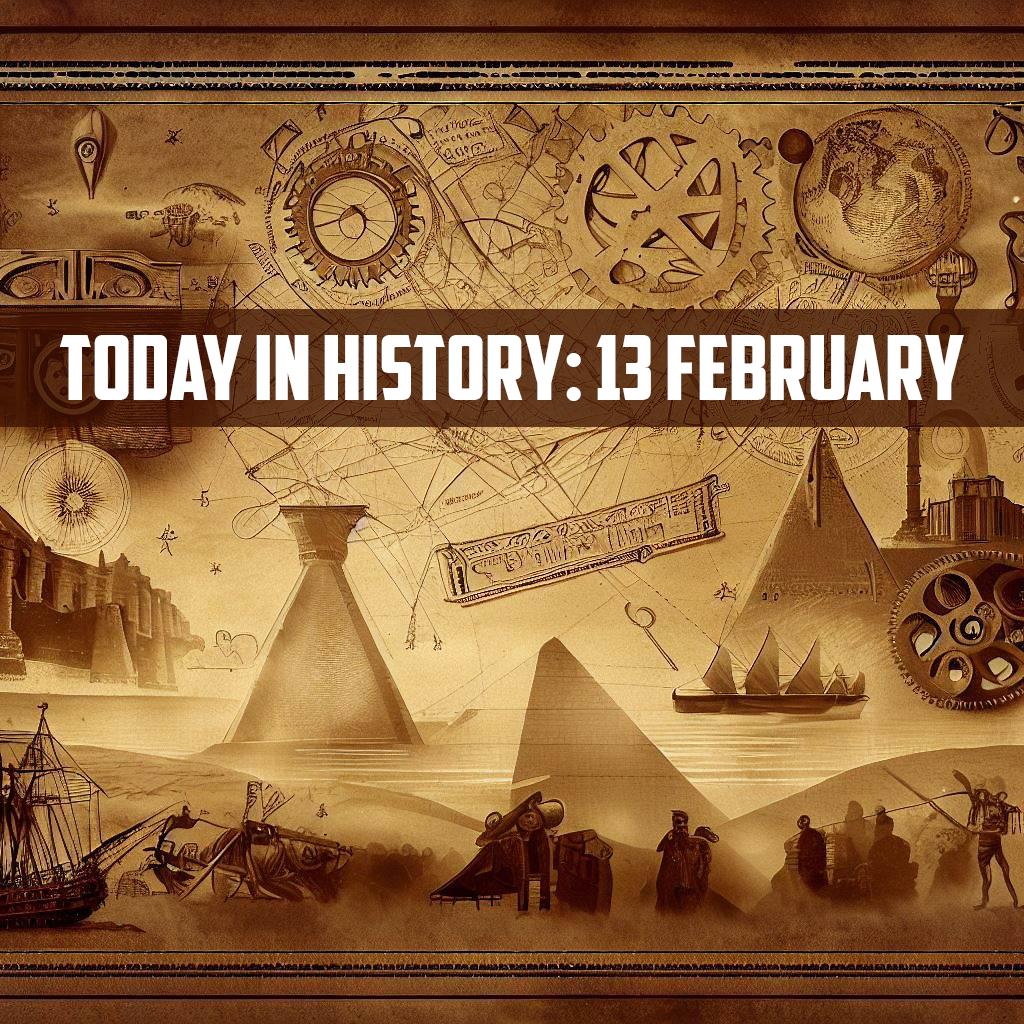
Throughout the course of history, each day has borne witness to events that have shaped civilizations, cultures, and the course of humanity itself. February 13th is no exception, with significant moments that have left indelible marks on the world’s timeline. Let’s journey through some of these transformative events and figures that made their mark on this day.
Today in History: 13 February

1. The Bombing of Dresden (1945)
World War II saw many cities suffer, but the bombing of Dresden by British and American air forces stands out as particularly devastating. Over a span of four days, beginning on 13 February 1945, a barrage of aerial bombings created a firestorm that decimated the city and resulted in significant civilian casualties. The reasons for the bombing remain a topic of debate, with many viewing it as an unnecessary act given the war’s imminent conclusion.
2. The ASCAP Formation (1914)
The American Society of Composers, Authors, and Publishers (ASCAP) was established on this day. This non-profit performance rights organization protects its members’ musical copyrights by monitoring public performances of their music and compensating them accordingly. Over the years, it has played a crucial role in ensuring that artists, composers, and publishers are fairly compensated for the public performance of their works.
3. The Introduction of the Penny Black (1842)
Though introduced in 1840, the Penny Black, the world’s first adhesive postage stamp, officially became valid for use in the British postal system on February 13, 1842. This revolutionary stamp laid the foundation for modern postal systems worldwide.
4. The Arrest of Bruno Richard Hauptmann (1932)
On this day, the tragic story of the Lindbergh baby kidnapping took a significant turn. Hauptmann was arrested and later found guilty of the crime, which involved the abduction and murder of aviator Charles Lindbergh’s young son. The case was widely publicized and brought issues of media ethics to the forefront.
5. The First Public Performance by The Beatles (1961)
While The Beatles had played in various settings prior, February 13th marked their inaugural concert at the Cavern Club in Liverpool. This performance set them on a trajectory to become one of the most influential bands in the history of music.
6. The Treaty of Constantinople (1832)
This day witnessed the signing of the Treaty of Constantinople, which made Greece a legally established sovereign state. After a long-fought war of independence against the Ottoman Empire, this treaty solidified Greece’s position in the international community.
7. The Foundation of The National Association of Colored Women’s Clubs (1896)
A merger between the National League of Colored Women and the National Federation of Afro-American Women gave birth to this association. It aimed to improve the lives and rights of African-American women, addressing issues from suffrage to education.
8. The Release of “Prince Valiant” (1937)
The iconic comic strip “Prince Valiant,” created by Hal Foster, made its debut. Set in the days of King Arthur’s Camelot, the narrative-driven strip stood out for its historical accuracy, attention to detail, and rich storytelling.
9. Radio Broadcasting in Tokyo (1925)
Japan’s first radio station began its broadcasts in Tokyo, marking the start of a new era in Japanese media and the wider dissemination of information and entertainment.
10. The Death of Richard Wagner (1883)
Noted German composer and conductor Richard Wagner passed away. Known for his epic operas and the use of leitmotifs, his works, including the renowned “Ring Cycle,” continue to influence music and theatre.
11. The Soviet Union Veto at the UN (1946)
The budding Cold War tensions became evident when the Soviet Union cast its first veto on the United Nations Security Council to block the Council’s discussion on Soviet involvement in Iran. It marked the beginning of a long series of East-West tensions within the UN during the Cold War era.
12. The First Robot-Assisted Surgery (1997)
Medical history was made when a robot was used to assist in a delicate surgery to resect a patient’s gallbladder. This event marked a leap in medical technology, paving the way for more complex robotic procedures that combined precision with minimally invasive techniques.
Conclusion
The 13th of February, like every other day, is a mosaic of events that span the breadth of human experience. From the realms of music to the corridors of diplomacy, from technological advancements to moments of profound tragedy, this day reflects the multifaceted nature of history. As we look back on these events, we are reminded of the intricate dance of circumstances that have brought us to our present moment. They serve as a testament to humanity’s ability to innovate, persevere, and above all, to evolve in the face of challenges. The stories of February 13th are not just tales of the past; they are a mirror reflecting our collective aspirations, failures, and the ceaseless march of time.